Monday, December 2, 2013

DigitalOcean Expands In Europe With New Amsterdam Data Center, Singapore ...


DigitalOcean, the quickly growing SDD-only web hosting and cloud infrastructure provider, launched its European flagship data center in Amsterdam today in an effort to keep up with growing demand for its services. The company also says it plans to launch in Singapore within the next two months and has already shipped equipment there to get its Asian operations off the ground.


The new Amsterdam data center (Amsterdam 2) is actually DigitalOcean's second one in the city. Both data centers are hosted by Telecity but are located in different buildings. Unlike Amsterdam 1, the new center features private network and an improved network design based around high-end Juniper routers. While the company plans to offer these features in all of its locations in the near future, they are only available in its New York 2 and Amsterdam 2 locations for now.


Today's expansion will allow DigitalOcean to finally offer the ability to launch instances in Europe again. For a few weeks now, starting instances (or 'droplets,' as DigitalOcean calls them) in Amsterdam 1 wasn't possible, because the company wasn't able to keep up with demand and ran out of capacity there. With the launch of the new data center, the company's CEO and co-founder Ben Uretsky told me last week, these kind of capacity crunches in Europe should now be over.


While Brazil remains the top-requested location for DigitalOcean's next expansion, the company will actually first go to Singapore. Brazil is a challenging market for DigitalOcean, Uretsky said, because of its high import taxes and poorly laid out network infrastructure. The company is considering the U.K. as its next target for its expansion after Singapore, though.


According to Uretsky, scaling remains DigitalOcean's main problem. Its latest funding round allowed the company to acquire about 130,000 new IP addresses, but its capacity is often pushed to the limits. With the new data centers coming online and new network and financing agreements in place, however, he thinks the company is on track to be able to meet customer demand going forward.


Looking ahead, the company plans to roll out IPv6 support across its locations, something its users have been asking for since the company started gaining traction earlier this year. While Uretsky wouldn't say when exactly this feature will launch, it doesn't seem like users who really need this capability will have to wait more than a few weeks.


Singapore provides street food showdown


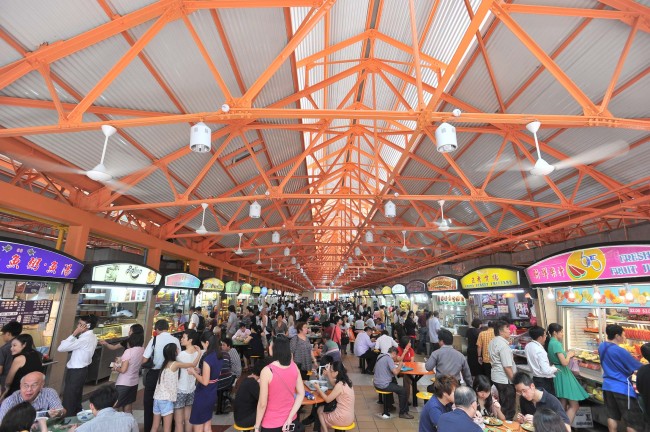
Patrons flock into the upgraded and revamped Maxwell Food Center, which opened Dec. 1, 2012. (The Straits Times)


Popular Hong Kong food blogger K.C. Koo picked Singapore's street food scene over Hong Kong's in an article in the Sunday Times recently.


The 45-year-old newspaper columnist was sponsored by the Singapore Tourism Board to write a food guide on the country's street food.


While focused predominantly on hawker fare, the guide also has options for afternoon tea and happy hour, which feature restaurants and bars.


Since the Sunday Times story, however, the article has sparked controversy on which city has better street food in terms of variety, flavor, consistency and quality. Foodies in the two cities weigh in.


Like fellow Hong Kong food blogger K.C. Koo, Hong Konger Janice Leung laments the loss of street food in her city and lauds Singapore's scene for its diverse cultures.


The 29-year-old food writer, whose articles have been published in the South China Morning Post and Wall Street Journal, says: 'I have heard that the demise of street food is a hot topic in Singapore, but compared to Hong Kong, it is alive and kicking.


'In Hong Kong, street hawkers are almost nonexistent because of licensing restrictions, and small shops are disappearing because of unsustainable rent hikes and homogenization brought about by chain stores.


'We have redevelopment plans that will knock down old buildings and force traditional food shops to close, but have no plans to offer them new spaces.


'If you define street food in Hong Kong as curry fish balls, stinky tofu and egg waffles, good versions of them are virtually nonexistent. Fish balls, for example, are more flour than fish and come from industrial producers. They are a far cry from the real thing.'


Leung, founder of farmers' market and social enterprise Island East Markets in Hong Kong, visits Singapore every five years and counts kaya toast, bak chor mee, Hainanese chicken rice and laksa as some of her favorite dishes here.


Foodies that SundayLife! spoke to all agree with Koo that Singapore's street food scene trumps that of Hong Kong's, and echo the sentiment that the Republic's hawker culture is much more vibrant.


According to Edward Chew, Singapore Tourism Board's regional director, greater China, Koo short-listed the stalls and restaurants for the guide ― which was in the works for six months ― on his own.


Chew says: 'We suggested 15 food categories from which Koo did his research on. We did not dictate the stalls and restaurants he wanted to visit and eventually include in the food guide. The stall owners were not informed of Koo's tasting sessions either. This guide serves as an insider's guide to the hidden gems of some of the most authentic hawker fare in Singapore.'


Leslie Tay of ieatishootipost.sg, 43, whose blog focuses on hawker food, says: 'I've known it all along. Our flavors are more robust and Hong Kong street food lacks the variety that we have, especially for Malay and Indian food. For example, laksa is the tastiest thing under the sun, nowhere else makes it like we do.'


Photographer Michelle Tng, 25, who moved to Hong Kong in March with her partner Davis Ng, a 28-year-old financial analyst, also lauds the variety in Singapore.


Tng says: 'We have a diverse range of dialects plus different ethnic groups, so we get different tastes and spices. In general, Hong Kong has predominantly one dialect type ― Cantonese. While it's really good, over time, the dishes start to be very similar.'


Dennis Wee, 61, chairman of real estate agency Dennis Wee Group, says: 'I think each place has its own individual style. But as a Singaporean, I would pick Singapore's food over Hong Kong's. Our hawker culture here is also stronger.'


Accessibility is key for Cheryl Lee, 27, a Singaporean postgraduate student at the University of Hong Kong who moved there in August.


She says: 'It's not easy to locate street food stalls in Hong Kong while in Singapore, we can just go to the hawker center to get what we want.'


While the outlook for Singapore's street food scene is still positive, those that SundayLife! spoke to also feel there is room for improvement.


Hong Kong-born master chef Lap Fai of Orchard Hotel's Hua Ting restaurant, 50, who moved to Singapore in 1991 and is now a citizen here, says: 'The issue here is that the prices for hawker food have gone up significantly over the years, making the 'street food' no longer as cheap as before.'


Civil servant Gwendolene Phua, 25, says: 'While I do think that Koo's views may be a bit biased, I prefer the flavors of our local street food. I will go to stalls where the hawkers make their dishes from scratch. More hawkers should do that.


'I also think that the push for the new generation of hawkers is a good thing and should continue.'


Perhaps the grass is greener on the other side.


That is the case for local foodies who pick Hong Kong's street food scene over the Singapore's, even though they do not deny that there is more variety in Singapore.


Systems engineer Wong Tiong Wee, 29, has a bone to pick with the definition of street food ― something he associates closely with what he eats in Taiwan, another destination famous for its street snacks.


He says: 'For Singapore, the blogger refers more to hawker food and not really street food ― food eaten on the streets.


'Our local food culture has a stronger heritage, but there are dishes such as bak kut teh (herbal pork stew) that we annot really claim as ours either. I would go to Hong Kong for great Chinese food.'


Singaporean housewife Karen Lim, 45, says: 'In Singapore, we get mass-produced sauces and ingredients in our hawker fare too. The taste is definitely not the same, and even if it is consistent, it can be consistently bad.


'Also, not everyone makes fishballs or popiah skin by hand now, which are dying trades here. I would pick Hong Kong as the better destination for street food because what I've eaten there so far has always been good.'


Singaporean business development executive Joshua Sum, 27, who is based in Hong Kong, says: 'Singapore doesn't have street food. In Hong Kong, you still can stand by the roadside and eat. People buy street snacks and stand around to eat out of styrofoam boxes, and stretch out to the stall counter for more condiments. You see something like that only at pasar malams (night markets) in Singapore.


'I wouldn't consider crabs or chwee kueh (steamed rice cakes) street food. It's not a like-for-like comparison that the blogger has done.'


In the food guide, Koo listed five restaurants specialising in crabs, including Chin Huat Live Seafood Restaurant at Sunset Way and Roland Restaurant at Marine Parade Central.


Other categories in the guide include char kway teow, nasi lemak, laksa and prawn noodles.


Human resources manager Carol Chan, 40, a Hong Kong citizen, says: 'Even though it's harder to find street food in Hong Kong now, I still prefer it over Singapore's food.


'The ambience is different, with everyone bustling around you eating egg waffles. It's a pity to know that that is disappearing.'


Chan travels to Singapore every year to visit friends and relatives living here, and enjoys eating satay, nasi lemak and curry chicken, among other popular local fare.


For the foodies that SundayLife! spoke to, the biggest point of contention with Koo's opinions was his comment on Singapore's seafood being fresher than Hong Kong's.


Hong Kong-based photographer Michelle Tng, 25, says: 'I disagree that seafood-wise, Singapore is fresher. I've eaten plenty of seafood in Hong Kong, not just prepared Cantonese style, even sashimi seems to be much fresher.'


Leslie Tay of the blog ieatishootipost.sg, 43, says: 'I'm not sure that our seafood is necessarily fresher unless Koo went to our wet markets. 'Hong Kong definitely has fresh live seafood.'


To preserve local street fare in Hong Kong, Hong Kong food writer Janice Leung hopes that there will be more action taken.


She says: 'One of the most important things is for young people to get into the business, learn traditional recipes and respect them.


'Governments need to actively assist with the continuation of street food culture, or at least avoid measures that will directly lead to its demise.'


By Eunice Quek (The Straits Times)


Sunday, December 1, 2013

Look to Singapore for efficient government spending

How would you feel about donating to a charity that uses more than half of your money for overhead costs? If that puts you off, then you should feel the same way about paying your income taxes.


Governments are notoriously inefficient at delivering taxpayer-financed programs. But finding data about how much of each dollar is spent for its intended purpose is difficult. Provincial budgets list expenditures by ministry (health or education, for example) but do not differentiate administrative overhead from total program cost. The 2012 Drummond report on reform of the Ontario public service gave a big clue: 'We estimate that labour costs amount to about half of all program spending.'


A bank clerk counts U.S. dollar banknotes on bundles of 100 Chinese yuan banknotes at a branch of a bank in Huaibei, Anhui province on April 26, 2012. The Chinese yuan set a new peak against the dollar on Oct. 14, 2013. REUTERS

Asia Video: Bad loans become big business in China

But administrative overhead involves more than labour; it also includes the capital and operating cost of government offices. This means the net amount of the Ontario taxpayer dollar reaching program beneficiaries is less than 50 cents. Other provinces may use taxpayers' money more efficiently than Ontario, but I doubt it.


Measuring the federal government's spending efficiency is complicated by the fact that 60 per cent of its revenues flow to provincial and municipal transfer payments. For money deployed directly, Ottawa's spending efficiency compares well with other Organization for Economic Development and Co-operation countries.


A study, 'Relative Efficiency of Government Spending and its Determinants,' presented by professors Eric Wang and Eskander Alvi at last year's Asia-Pacific Economic Association conference in Seattle assessed the degree to which government spending contributed to an increase in GDP in 10 Western countries in the 1981-2008 period. Canada ranked fourth, behind the United States, New Zealand and Germany - a big improvement from 2001, when Canada ranked last.


But much more needs to be done. A Fraser Institute study published last month, using federal auditor-general data, said that federal governments had wasted as much as $197-billion over the past 25 years, leaving the Harper government's drive to improve efficiency a lot of room for improvement.


Not surprisingly, the Wang/Alvi study found that government spending efficiency improves as private-sector production, consumption, investment and exports increase; it declines as government spending rises. Interestingly, it also found that 'monetary expansion,' or increasing the money supply, lowers government spending efficiency. And it found a strong correlation between government spending inefficiency and economic malaise. This is aptly demonstrated by economically stagnant, debt-laden France, which has the highest spending-to-GDP ratio of any OECD country.


When it comes to efficient government spending, Singapore offers a straight stick against which others can be measured. A recent World Bank paper ('Social service delivery: Singapore') shows the country delivers high-quality public services at a low cost. It spends just 2.6 per cent of GDP on education, half the OECD average, yet students rank 10 places above Canada in math, science and reading skills. Singapore creates strong incentives for students to perform well in standardized national tests and chooses educators from the top 30 per cent of teaching graduates. The result is superior achievement for students and high public esteem for teachers.


More astounding is the value-for-money achieved by Singapore's health-care system. Government health-care spending is a meagre 1.4 per cent of GDP, the World Bank paper notes, compared with the OECD average of more than 7 per cent. Life expectancy is 81.4 years and child mortality is just 2.2 per thousand births. Singapore hospitals publish online reports of waiting times, including how long it takes to see a doctor in emergency and, if needed, get a hospital bed. (Last week, that waiting time averaged less than five hours.)


The Singapore system provides universal coverage through a combination of compulsory savings and government subsidies to ensure affordability for all. The private sector provides about 75 per cent of publicly funded patient care. Those wanting upgraded accommodation make co-payments beyond what the state covers. The result is the world's most efficient and effective universal public health care system.


The combined spending of Canada's federal, provincial and municipal governments totals more than $750-billion per year. Improving the value-for-money from these enormous expenditures couldn't be more important. Laying a straight stick alongside our country's bent and twisted ones would be a good place to start.


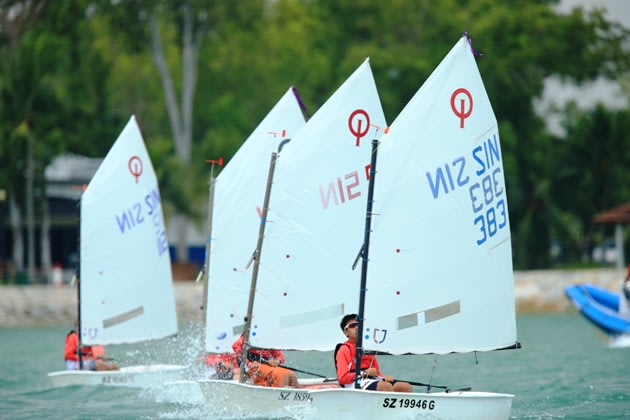
Singapore's SEA Games sailors prove the sport is for one and all

(Photo: Singapore Sailing Federation)


The 2013 Southeast Asian (SEA) Games in Myanmar will be particularly special for Singapore sailors Bertha Han and Anthony Kiong.


One makes her debut at 15; the other, aged 38, marks his return to action since last competing for the nation 15 years ago.


Together, Han and Kiong are testament to the diversity and spread of sailing in Singapore, according to Singapore Sailing Federation (SSF) president Dr Benedict Tan.


'We expect it to be a mainstream sport one day,' the national sailing icon told Yahoo Singapore at a November event announcing the SSF's SEA Games squad.


Kiong, who started sailing at seven and is headed to his fifth SEA Games campaign, agreed that it was only a matter of time. 'Interest has been growing over the years, especially since we've won the Optimist World Championship for three years in a row now.'


This year's Optimist female world champion is none other than Han, and the diminutive, 1.5m-tall girl is just one of a supremely 'talented' bunch of young sailors, said both Kiong and Tan.


Singapore's Bertha Han. (Photo: Singapore Sailing Federation)


No ageism

Han, who expects to strike gold at the SEA Games, is already looking as far ahead as the 2020 Olympics.


Her daily motivation, said the Raffles Girls School student, is the sheer passion for the sport displayed by her teammates cum role models.


She was yet to be born when Kiong struck SEA Games gold in 1993 and 1997, but just hearing the story of his comeback is undoubtedly a lesson on keeping the fire burning in one's belly.


'I grew up sailing and it's what I'm really passionate about,' said Kiong, who will compete in the half-rater category with his partner, 36-year-old pilot Stanley Chan.


'After the Asian Games in 1998, I stopped for 15 years,' he recalled. 'When I stopped, I felt like there was something missing.'


At Chan's persuasion, Kiong signed up for - and won - a race in October last year. 'I felt very happy when I was sailing again,' said the marketing manager, and promptly decided to take a crack at making the 2013 SEA Games squad.


'Anthony is an inspiration,' said Tan, himself a four-time SEA Games gold-medallist who sailed alongside Kiong in the 1990s. 'We didn't make it easy for him and he qualified on his own merit.'


Singapore sailors Anthony Kiong (left) & Stanley Chan. (Photo: Singapore Sailing Federation)


Sport of the future

Tan, 46, is hoping for more Singaporeans to develop a passion for sailing that runs as deep as Kiong's.


The 1994 Asian Games champion reminded Yahoo of SSF patron, ex-national sailor and International Olympic Committee vice-president Ng Ser Miang's long-expressed desire for sailing to become a national sport.


He then said the federation has 'been systematically working towards' a target of '80% of Singaporeans sailing'.


Either way, Tan is convinced that sailing is the sport of the future for the land-scarce country.


'People need an outlet. People need recreational space. Look at MacRitchie (Reservoir Park) and how crowded it is. You can't even find parking!' laughed the three-time Sportsman of the Year.


'The sea has so much space, why don't we just go and sail? We even have a presence at Marina Bay, so at lunchtime you can go and sail too (sic).'


But first, there are barriers that must be removed, said Tan, pointing to Singapore's restrictions on activities such as towing boats on the roads and launching boats from any location on the beach.


Dr Ben Tan with Bertha Han. (Photo: Singapore Sailing Federation)


Rich man's game?

The biggest hurdle to the public's acceptance of sailing may yet be its image as an exclusive, luxurious habit for the more financially capable.


'This is a misconception we want to correct,' said Tan. 'Nobody says you must own a big boat with huge sails and air-conditioning, with one hand holding the steering wheel and the other a beer.'


'Don't think that is sailing. It's part of it but we also cater to a whole spectrum.'


The Singapore sporting great admitted that club membership is necessary for one to start sailing, but noted that the SSF provides 'alternative avenues'.


'If you love to sail and want to race, but have no money to join a club, we have a virtual, non-brick-and-mortar club that's free-of-charge and just for the formality,' said Tan.


Still another expensive aspect of sailing, as earlier called out by Han, is the cost of equipment, but Kiong disagrees.


'A lot of schools have sailing as a co-curricular activity. You can sail without owning a boat and the Federation provides boats too anyway,' he argued.


Tan also chimed in with a nugget of his own storied experiences in the local sailing scene. 'When I started, I never owned a boat. I used the club's,' said the 1993 Public Service Medal and 1995 Public Service Star receiver.


'My first boat ever was second-hand, 13 years old, and cost me about S$3,000,' he reflected. 'Piano, violin, dance and even gym lessons cost more than that.'


Singapore's sailors launch their SEA Games campaign on 13 December. Catch all the action at the 2013 SEA Games from 5 - 22 December in Myanmar, here on Yahoo Singapore. Related stories Fast-improving kayakers chase SEA Games glory with eye on OlympicsSingapore's only female rower fights for the fate of her sport

I defer NS because I love Singapore: Joseph Schooling

Joseph Schooling and his parents May and Colin. (Yahoo Photo)


Is representing Singapore in sports equivalent to doing National Service (NS)?


Days after this bold suggestion by his mother, Singapore's top swimmer Joseph Schooling gave his own take on the continuing dialogue over his deferment from NS.


'I'm not in the right position to make that call,' the 18-year-old told Yahoo Singapore, after his Southeast Asian (SEA) Games send-off ceremony on Saturday.


'But I'm doing this because I love my country. I want to bring pride and glory to my country.'


That will take shape in a first-ever medal for Singapore at the 2016 Olympics: the lofty goal that Schooling has now devoted his life to, minus -- for now -- a two-year military stint that all Singaporean men undergo.


The US-based high school student added, 'If you ask me if swimming itself is a form of NS, I couldn't answer that question.'


'It's not up to me. My job is to swim,' he said.


Joseph Schooling at the FINA World Championships in Spain, July 2013. (Getty Images)

Whatever it takes

Few would deny that Schooling has done a fine job so far.


At 16, the butterfly specialist won two gold medals at the 2011 SEA Games and became an Olympian just a year later. He now holds five individual national records in the 200m freestyle, 200m individual medley, and 50m, 100m and 200m butterfly events.


Even as the teenager revealed his ambition for a six-gold medal haul at December's SEA Games in Myanmar, he also moved to highlight his willingness to eventually complete what is expected of him.


'I want to do something special for Singapore, in terms of the Olympics,' he said. 'And if that means taking more time to swim and after that, coming back and serving NS for two years, I'll do it.'


The 1.84m-tall athlete is level-headed beyond his years, a trait made all too clear as he addressed the presence of detracting remarks over his pursuit of sporting excellence.


'I'm always open to criticism,' said the affable 2012 Sportsman of the Year. 'I listen and I think what I can do to use that criticism to my advantage.'


And whatever the naysayers hurl at him, one formula seems to work every single time.


'I'll just train harder,' declared Schooling. 'And prove you guys wrong.'


Joseph Schooling and the rest of Singapore's national swimmers launch their SEA Games campaign on 12 December. Catch all the action at the 2013 Games from 5 - 22 December in Myanmar, here on Yahoo Singapore. Related stories Joseph Schooling's mum on NS debate: Swimming for Singapore is also 'national service' Singapore's SEA Games swimmers make the case for NS deferment Singapore water polo boys confident of upholding proud SEA Games heritage

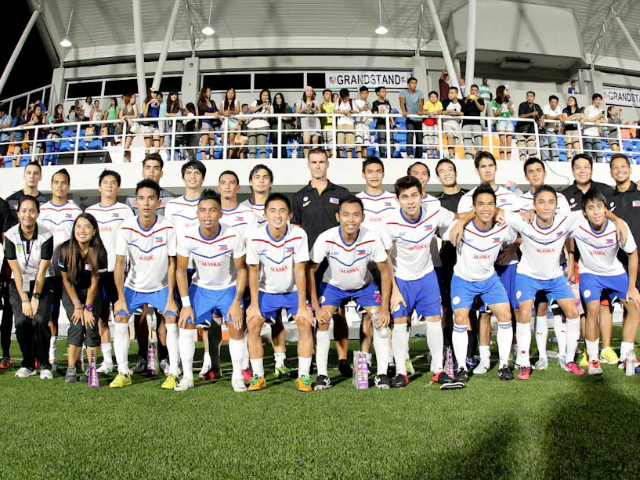
U23 Azkals surrender six goals in charity game versus Singapore


The Under-23 incarnation of the Philippine men's football team lost 6-0 to the Singapore national squad on Sunday at the Hougang Stadium, in a charity game with proceeds directed towards Super Typhoon Yolanda relief.


FT: Singapore U23 6-0 Philippines U23 - Azkals (@PHI_Azkals) December 1, 2013


After losing to Singapore in a close affair, 1-0, last June, the Philippines found themselves trailing by a similar scoreline entering the half, following a 28th minute goal by the home side.


Coming out of the break, Paolo Pascual replaced Nick O'Donnell as keeper, but the change had a negative effect, as a barrage of Singapore scores gave them a one-sided win, thanks to conversions at 52', 56', and 70'.


FULLTIME at the Hougang Stadium: Singapore U23 6-0 Philippines U23 (Nazrul 28'; Shahfiq 52'; Sahil 56'; Hafiz 70'; Iqbal 90'; Madhu 90')!!! - Gabe Tan (@gabetan13) December 1, 2013


As if that was not enough, Singapore then added two more scores at the 90th minute, before the final score was etched in stone.


Six different Singaporeans got on the scorer's sheet in the rout. - AMD, GMA News


Saturday, November 30, 2013

Jake Ellenberger Out of UFC Singapore Main Event, UFC Taps Hyun Gyu Lim vs ...


The main event for the UFC 's Singapore debut fell apart on Thursday, but the promotion already found a way to put it back together less than 24 hours later.


Jake Ellenberger had to withdraw from the UFC Fight Night 34 main event due to an undisclosed injury on Thursday, but UFC officials quickly moved to insert Hyun Gyu Lim in his stead. Lim will face off with former Strikeforce champion Tarec Saffiedine.


Lim (12-3-1) was already scheduled to fight Kiichi Kunimoto on the card, before being asked to step into the headlining role. Kunimoto will now face Luiz 'Besouro' Dutra, according to UFC officials.


Lim is currently on a seven-fight winning streak including victories in his first two UFC bouts. He knocked out Marcelo Guimaraes at UFC on Fuel TV 8 and Pascal Krauss at UFC 164.


Saffiediene has won his last four fights, including defeating Nate Marquardt for the Strikeforce welterweight championship in his final bout for the company before parent company Zuffa folded it into the UFC.


That was in January, so Saffiedie's UFC debut has been a year in the making.


A Pancrase and Heat veteran, Kunimoto (15-5-2) is riding four consecutive victories into the fight with Dutra. Dutra (11-2-1) is another fighter on a four-fight winning streak. Both Kunimoto and Dutra are making their UFC debuts.


UFC Fight Night 34 is slated for Jan. 4 in Singapore. It will air on Jan. 3 in the United States due to the time difference.


Like MMAWeekly.com on Facebook and Follow @MMAWeeklycom on Twitter.